
A history of Castleknock
A castle on a hill, a church that lost its spire and a clock tower that supplied a house with water.The village in pictures, past and present.
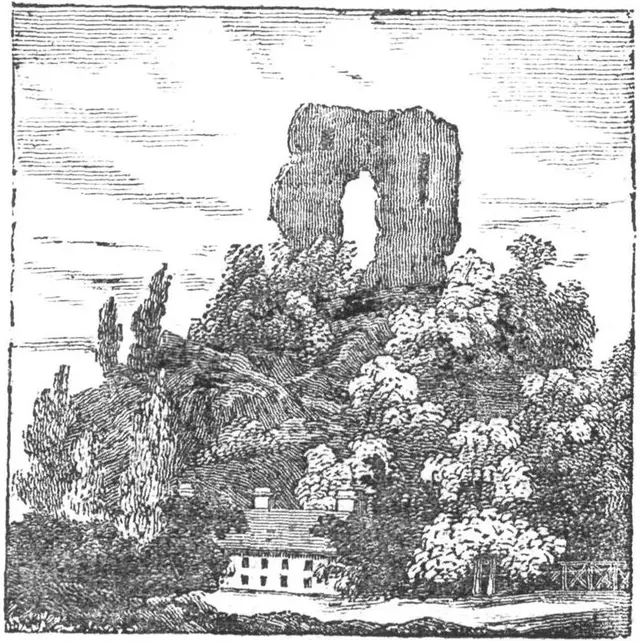
The hill came first. Medieval Irish tradition remembers it as Cnucha. In the late twelfth century Hugh Tyrell held the manor here. His family’s castle rose above the earthworks that survive in the grounds of Castleknock College.
Explore the illustrated history and landmark mapFingal’s account of the castle

Castleknock through time
1803–1957
The missing spire of St Brigid’s
Stand outside St Brigid’s today and the tower ends in four pinnacles. In the old photograph, a slender spire rises high above them. It came later than the church itself. The foundation stone was laid in 1803 and the building was finished in 1810.
Friends of James Hans Hamilton, the county’s MP, added the spire in his memory in 1864. Lightning damage led to its removal in 1957. The west window and the shape of the gable make it easy to match the two views.


1662–1747
When the gates opened
The fallow deer were here before the public. The Duke of Ormond established the Phoenix Park as a royal deer park in 1662. In 1747, the Earl of Chesterfield opened it to the public. The Castleknock Gate still marks one end of the avenue that runs towards the city.

Late 1700s–1840s
Why there are two bridges
At Castleknock Road, the older Granard Bridge crossed the Royal Canal. When the railway arrived alongside it in the 1840s, the road needed a second bridge. West towards Clonsilla, canal builders had already blasted a channel through limestone. Here in the Deep Sinking the towpath rises more than nine metres above the water in places.
1835
School begins on College Road
Fr John McCann bought the first part of the College grounds for £3,600 in 1834. St Vincent’s opened the following August. Its first pupil, John Lynch from Clones, recalled arriving before the other boys and spending the time exploring the hills. He later became Toronto’s first archbishop.
For most of its history, the College was a boarding school. Day pupils arrived in 1987 and the last boarders left in 2006. The dormitories became classrooms.
The College’s historyView the College in the Lawrence Collection

1873–1999
The clock that hid a reservoir
Edward Cecil Guinness bought Farmleigh in 1873. The Georgian house grew a third storey, a ballroom and a conservatory. Outside, the clock tower erected in 1880 had another purpose. Behind its stone walls was a water tank.
In 1910, a pump house at the Strawberry Beds harnessed water from the Liffey. The system fed the tower’s reservoir and generated electricity for the house. The Irish State purchased Farmleigh in 1999. The estate now welcomes the public and hosts visiting heads of state.
Inside the clock towerFarmleigh’s historic maps and photographs